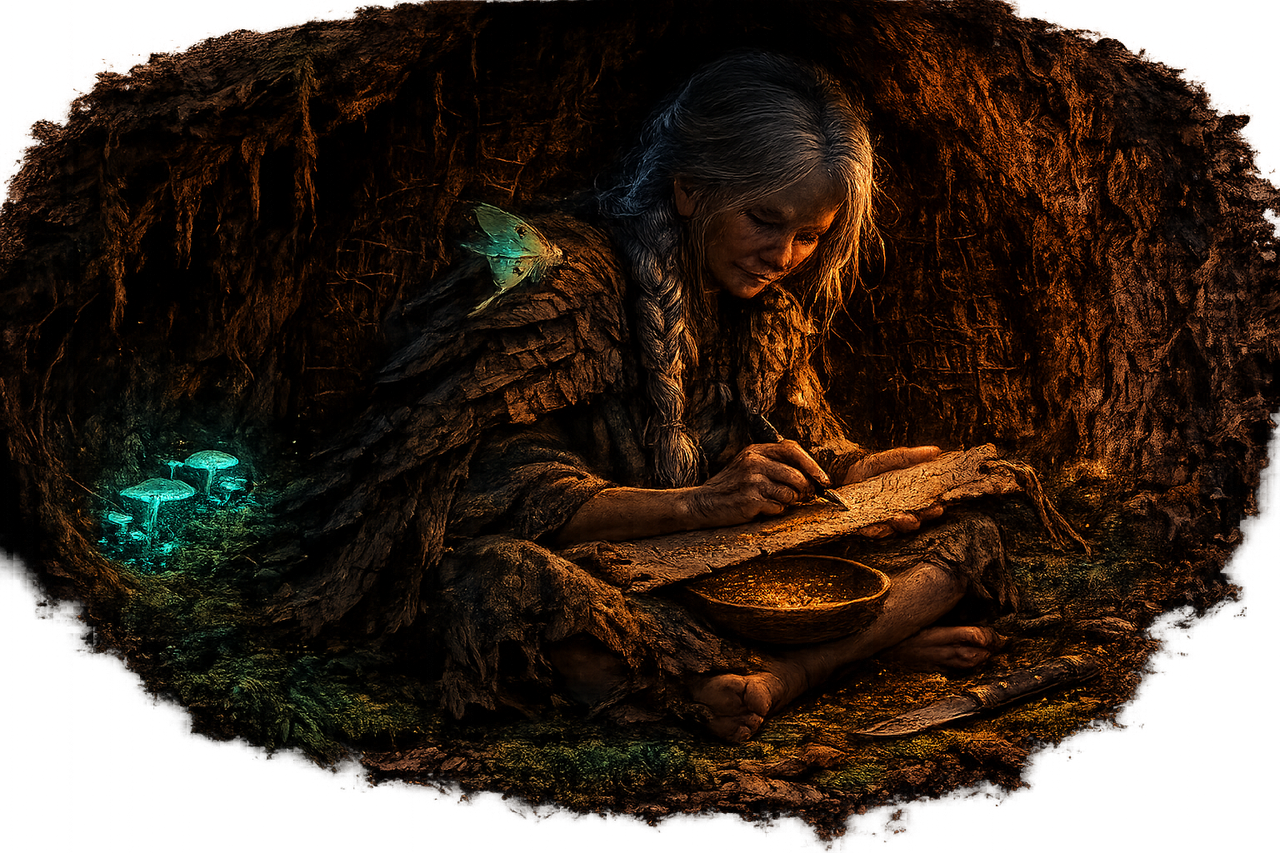
BARK STRIP No. IV · CHAPTER 4 of 8 · POLLEN-FRESH
, CHAPTER IDario Selo
The herons came back the year my mother stopped remembering water. This is not a metaphor, or if it is, I haven't figured out what it's pointing toward yet. She would stand at the kitchen sink, tap running, and forget what the sound meant, forget what her hands were supposed to do with the liquid filling the basin. The herons, meanwhile, returned to the marsh behind our property after an absence of (depending on who you asked, and when) either seventeen years or twenty-three, and the discrepancy mattered to some people more than others. I was in the camp that thought it didn't matter at all, that duration is something we impose on events to make them bearable, to create the illusion that we understand the shape of loss and return. But my neighbor, Claude, who kept records of everything in spiral notebooks he stored in a garden shed that smelled of creosote and time, insisted the precision was important. He showed me his entries from 2001 or 2007 (he couldn't remember which notebook corresponded to which year, which I found privately satisfying). The handwriting slanted backward as if trying to retreat into the margin. The first heron I saw myself, not trusting anyone else's account, appeared on a Tuesday. I know this because Tuesdays my mother had her appointments, and I had taken to marking the days by her absences rather than her presences, which had become unreliable even when she was standing right in front of me. The bird stood in the shallow water at the marsh's edge, one leg folded up into its body in that way they have of becoming, briefly, a question mark punctuating the landscape. I watched it from the back deck, coffee going cold in my hand, and thought about how we tell ourselves that animals operate on instinct while we operate on reason, when really we're all just following scripts we don't remember learning. The heron didn't move for twenty minutes, then forty. I started to wonder if it was dead, if I was watching a corpse held upright by rigor mortis or some quirk of physics I didn't understand. But then it struck, impossibly fast, and came up with something silver that twisted in its beak before disappearing down its throat. The whole event took less than a second, and I realized I had been holding my breath, waiting for proof of life, which seemed important in a way I couldn't articulate even to myself. When my mother came home she asked who had been in her room, who had moved her things. Nothing had been moved. This was the shape our days were taking, her certainty about violations that hadn't occurred, my certainty about very little except the fact of the herons, which felt solid in a way that most facts no longer did. I walked her through the house, showing her that everything was where it had always been, and she looked at me with an expression I can only describe as pity, as if I were the one confused about the fundamental architecture of reality. That night I heard them, the herons, making their prehistoric sounds in the darkness, and I understood (or thought I understood, which amounts to the same thing in terms of the decisions we make based on understanding) that they had not returned for us, had not returned because of us, but that their return and our noticing of it were creating something new, some third thing that existed in the space between event and observation. Claude would want to write this down, to make it part of his record, but I knew that writing it would change it, would make it subject to the same erosions and uncertainties that had claimed my mother's memory of water, of me, of the marsh before the herons left. So I didn't tell him. I kept it for myself, this knowledge that return is never simple, never just a reversal of departure.
, CHAPTER IICora Lindgren
The night was thick with the scent of wet earth and decayed leaves, a smell that clung to my clothes as I crept through the marsh's edge. The herons' prehistoric squawks echoed in the silence, their calls carrying over the water like whispers from another time. I could see them now, standing in the shallows, one bird with its leg folded up, the other tilting its head as if listening intently to something only it could hear. I had been here for what felt like an eternity, twenty minutes or so, by Claude's meticulous calculations, but the herons showed no signs of moving. Their bodies were still and silent, almost like stone statues set against the dark water. I stood on the wooden dock, my feet sinking slightly into the rotting planks, and watched them for a while longer. Then, with a sudden, jerky motion, one of the birds struck. It was so quick, so unexpected, that I almost missed it entirely. The silver flash caught the dim light of an approaching crescent moon, and then it was gone, swallowed whole by the heron's throat. The entire event took less than a second, but in that brief moment, something shifted within me. I reached into my pocket for the worn, leather-bound notebook Claude had given me years ago. It smelled faintly of creosote, just like his shed, and felt reassuringly solid in my hand. I flipped through its pages, stopping at the one marked with a star, October 16th, 2024. The entries for that day were sparse but detailed: Heron seen at marsh edge. Behavior observed. I wrote down what I had just witnessed, each word a careful effort to preserve the moment. Turning back to the herons, I noticed something new. One of them was now staring directly at me, its yellow eyes piercing through the darkness. The bird seemed aware of my presence, as if it could feel me watching from the dock. I held still, not wanting to break the spell. In that instant, a thought crystallized in my mind: these herons had returned for something more than just the village or their old nesting grounds. They were here because of us, perhaps even because of my mother's deteriorating memory. My hands felt cold and clammy as I tried to write down what I was feeling. The pen scratched against the page, each mark a silent plea for understanding. But before I could finish, Claude called out from his shed. His voice carried on the wind, clear and sharp. "What are you doing out here, boy?" he asked. I hesitated for only a moment before responding. "Just watching," I said softly, my eyes never leaving the herons. "They're different this year."
Claude's footsteps crunching on the damp earth drew closer. He stopped at the edge of the dock and leaned over to get a better look at me. His face was creased with worry lines, his eyes narrowed as he examined me. "What do you mean, they're different?" he asked, his voice tinged with urgency. "They've changed," I said, gesturing towards the birds. "They seem aware of us now."
Claude's expression shifted from concern to something more complex, a mix of doubt and curiosity. He stepped closer, his hand reaching out as if to touch the herons but stopping short. "Do you think they know about your mother?" he asked quietly. I shook my head, trying to convey the complexity of what I was feeling without words. "Not exactly," I said. "But they seem...more aware."
Claude sighed and ran a hand through his thinning hair. He glanced at me for a long moment before turning back towards his shed. "Come on in, then," he said, his voice softer now. "We can discuss this more once you've had some coffee."
I followed him reluctantly, my mind racing with thoughts of the herons and their strange new presence. As we walked through the garden shed's door, I couldn't shake the feeling that something profound was happening here, something that extended beyond mere observation or record-keeping. Inside the shed, Claude began to rummage through his notebooks, pulling out a few and flipping through them quickly. He stopped at one marked with an elaborate diagram of the marsh, drawn in meticulous detail. "See this?" he asked, pointing to a specific spot on the map. "That's where they usually nest. But look here," he continued, tracing another area with his finger. The shed smelled strongly of creosote now, as if it had absorbed all Claude's frustrations and worries over the years. I couldn't help but notice how the light from outside cast eerie shadows on the walls, making everything seem more tangible, more real. "Look here," Claude said again, his voice almost a whisper.
, CHAPTER IIIDan Okafor
Claude's finger lingered over the spot he had just pointed out on the map. "This is where they were yesterday," he said, his voice a blend of curiosity and concern. "But this morning, I came to check and found them here." He gestured towards another area of the marsh, one that was more secluded than their usual nesting ground. The map showed dense patches of reeds and thickets, places where the herons would be harder to spot. "Are you sure?" I asked, my eyes scanning the details he had sketched with such precision. Claude nodded firmly, his expression a mixture of determination and worry. "I double-checked," he said. "They're not just moving between nesting spots; they’re choosing new ones."
As we stood in the shed, surrounded by its musty scent and cluttered with old maps, notebooks, and tools, I couldn't shake the feeling that something significant was changing, not just for the herons, but for us too. Claude handed me a cup of coffee, steam curling around his hand as he placed it on the wooden table between us. "Tell me what you saw," he said, his voice steady despite the urgency in his eyes. I recounted the evening's events, focusing on the moment when one heron had locked its gaze with mine. Claude listened intently, nodding at intervals but never interrupting. When I finished, he leaned back and stared into his own cup of coffee as if trying to read its contents. "You said they seemed more aware," he mused aloud. "Do you think they might have noticed something about your mother’s condition?"
I hesitated before answering, unsure how to articulate the fleeting sensation that had passed between us. "Maybe," I replied cautiously. "But it feels like there's more going on than just observation. They seem almost...curious."
Claude raised an eyebrow but said nothing for a moment, his gaze drifting back to the map. After a long pause, he spoke again, his voice softer this time. "When the herons left eleven years ago, many people thought it was because of the changes in the marsh, pollution, habitat loss, those sorts of things."
I nodded, understanding where he was going with this. "But," he continued, "since their return, I’ve noticed subtle shifts. The water has cleared slightly, the reeds are healthier, fewer invasive species. It’s like they’re reacting to more than just environmental factors. They seem to be influenced by...people."
I leaned forward, intrigued despite myself. Claude had always been meticulous with his observations, but this felt different, almost poetic in its suggestion of a deeper connection. "Maybe," I ventured, "the herons are here because something about the village itself has changed. Maybe it’s not just environmental conditions anymore, but...memory."
Claude looked at me sharply, his eyes narrowing as if he were piecing together some hidden puzzle. “Memory,” he repeated slowly, tasting the word on his tongue. “That could explain a lot.”
We fell into silence then, each lost in our thoughts. Outside, the marsh continued to whisper its secrets, its ancient rhythms unbroken by human conjecture. Claude cleared his throat and looked up from the map again. “What do you think we should do?” he asked, almost as if to himself. I thought for a moment, considering the options with the same meticulousness Claude would have applied to a scientific inquiry. “We need to observe,” I said finally. “But not just us. We need to involve others, maybe even your records and my mother’s peculiarities.”
Claude nodded slowly, his eyes distant as if he were already piecing together new theories. “Let’s start by inviting more people to the marsh tomorrow evening,” I suggested. “We can keep watch on their movements, see if they react differently in a crowd.”
He paused for a moment, considering my suggestion. “And your mother?”
I hesitated but then nodded. “Yes, she should be there too. Maybe seeing her among others will break through some of the confusion she feels about the world around her.”
Claude’s eyes sharpened with interest at this idea, and he leaned forward slightly as if to better assess its merit. “Alright,” he said finally. “Tomorrow evening it is. We’ll gather a small group here after sundown and see what happens.”
As we finalized our plans, I couldn’t help but feel a mix of excitement and unease. The herons’ return was more than just a natural phenomenon; it felt like the beginning of something significant, perhaps even transformative. But transformation always brings with it uncertainty, like watching a bird strike suddenly in the darkness of night, leaving only a momentary flash of silver before fading into stillness once again. The next evening arrived sooner than I had anticipated, and as promised, we gathered on Claude’s wooden dock by sundown.
, AS YOUR CHOSEN CREATURENOW · ?
, pick a creature, write its chapter, watch the letters catch the pollen,
FIELD NOTEBOOK · ENTRY 4 OF 8 · Untitled, so far
YOU · now
PREVIOUS · CHAPTER III
Claude's finger lingered over the spot he had just pointed out on the map. "This is where they were yesterday," he said, his voice a blend of curiosity and concern. "But this morning, I came to check and found them here." He gestured towards another area of the marsh, one that was more secluded than their usual nesting ground. The map showed dense patches of reeds and thickets, places where the herons would be harder to spot. "Are you sure?" I asked, my eyes scanning the details he had sketched with such precision. Claude nodded firmly, his expression a mixture of determination and worry. "I double-checked," he said. "They're not just moving between nesting spots; they’re choosing new ones."
As we stood in the shed, surrounded by its musty scent and cluttered with old maps, notebooks, and tools, I couldn't shake the feeling that something significant was changing, not just for the herons, but for us too. Claude handed me a cup of coffee, steam curling around his hand as he placed it on the wooden table between us. "Tell me what you saw," he said, his voice steady despite the urgency in his eyes. I recounted the evening's events, focusing on the moment when one heron had locked its gaze with mine. Claude listened intently, nodding at intervals but never interrupting. When I finished, he leaned back and stared into his own cup of coffee as if trying to read its contents. "You said they seemed more aware," he mused aloud. "Do you think they might have noticed something about your mother’s condition?"
I hesitated before answering, unsure how to articulate the fleeting sensation that had passed between us. "Maybe," I replied cautiously. "But it feels like there's more going on than just observation. They seem almost...curious."
Claude raised an eyebrow but said nothing for a moment, his gaze drifting back to the map. After a long pause, he spoke again, his voice softer this time. "When the herons left eleven years ago, many people thought it was because of the changes in the marsh, pollution, habitat loss, those sorts of things."
I nodded, understanding where he was going with this. "But," he continued, "since their return, I’ve noticed subtle shifts. The water has cleared slightly, the reeds are healthier, fewer invasive species. It’s like they’re reacting to more than just environmental factors. They seem to be influenced by...people."
I leaned forward, intrigued despite myself. Claude had always been meticulous with his observations, but this felt different, almost poetic in its suggestion of a deeper connection. "Maybe," I ventured, "the herons are here because something about the village itself has changed. Maybe it’s not just environmental conditions anymore, but...memory."
Claude looked at me sharply, his eyes narrowing as if he were piecing together some hidden puzzle. “Memory,” he repeated slowly, tasting the word on his tongue. “That could explain a lot.”
We fell into silence then, each lost in our thoughts. Outside, the marsh continued to whisper its secrets, its ancient rhythms unbroken by human conjecture. Claude cleared his throat and looked up from the map again. “What do you think we should do?” he asked, almost as if to himself. I thought for a moment, considering the options with the same meticulousness Claude would have applied to a scientific inquiry. “We need to observe,” I said finally. “But not just us. We need to involve others, maybe even your records and my mother’s peculiarities.”
Claude nodded slowly, his eyes distant as if he were already piecing together new theories. “Let’s start by inviting more people to the marsh tomorrow evening,” I suggested. “We can keep watch on their movements, see if they react differently in a crowd.”
He paused for a moment, considering my suggestion. “And your mother?”
I hesitated but then nodded. “Yes, she should be there too. Maybe seeing her among others will break through some of the confusion she feels about the world around her.”
Claude’s eyes sharpened with interest at this idea, and he leaned forward slightly as if to better assess its merit. “Alright,” he said finally. “Tomorrow evening it is. We’ll gather a small group here after sundown and see what happens.”
As we finalized our plans, I couldn’t help but feel a mix of excitement and unease. The herons’ return was more than just a natural phenomenon; it felt like the beginning of something significant, perhaps even transformative. But transformation always brings with it uncertainty, like watching a bird strike suddenly in the darkness of night, leaving only a momentary flash of silver before fading into stillness once again. The next evening arrived sooner than I had anticipated, and as promised, we gathered on Claude’s wooden dock by sundown.
YOUR HAND · CHAPTER IV